
A salary budget is only one line in the cost of hiring. The decision becomes clearer when finance, hiring managers, and leadership can see the same assumptions in one place.
This guide gives you a practical role-cost calculator. It is not a benchmark and it does not assume every company pays the same recruiter fee, employer costs, or cost of delay. Replace the example numbers with your own approved figures before making a hiring decision.
What does a new hire really cost?
Use this first-year formula:
First-year role cost = cash compensation + employer costs + benefits and tools + sourcing or recruiter fees + onboarding and ramp cost + vacancy cost.
The formula matters because two hiring routes can show the same salary or monthly rate while producing very different total costs. A lower visible price can still be the more expensive decision if the role stays open longer, absorbs more internal time, or adds a large one-off fee.
The six cost buckets to put in the model
1. Cash compensation or specialist rate
For an employee, start with base salary plus any expected bonus, commission, or guaranteed allowance. For an independent or managed specialist, use the contracted monthly or hourly rate for the period you expect to need the role.
Keep the comparison period consistent. If you model an employee over 12 months, model every other route over the same 12 months.
2. Employer costs, benefits, and equipment
Add the costs your company will actually incur in the hiring location. Depending on the arrangement, this can include employer taxes or social contributions, insurance, paid leave, pension contributions, equipment, software, workspace, and allowances.
Do not use a generic percentage if finance or payroll can provide the real number. The purpose of the calculator is to improve the decision, not to create false precision.
3. Sourcing and recruiter fees
Include every external sourcing charge and any internal recruiting time. If an agency quotes a percentage of annual salary, convert that percentage into currency and show it as a separate line.
For example, a 20% fee on a €90,000 salary would be €18,000. That is an illustration of the arithmetic, not a claim that every recruiter charges 20%.
4. Internal hiring time
Hiring has an internal cost even when no agency is involved. Estimate the hours spent by recruiters, hiring managers, interviewers, finance, legal, and operations, then multiply those hours by a sensible blended hourly cost.
Include time spent writing the brief, sourcing, screening, interviewing, coordinating, negotiating, and setting up the engagement.
5. Vacancy cost
Vacancy cost is the value lost or delayed while the role remains unfilled. It might show up as postponed releases, slower sales support, overtime, contractor cover, founder time, or work that never starts.
A simple model is:
Monthly cost of delay × expected months unfilled.
Use a defensible internal estimate. If the impact is uncertain, model a low, expected, and high case instead of pretending there is one exact number.
6. Onboarding and ramp cost
The role is not instantly productive on day one. Add onboarding time from the new hire and the colleagues supporting them, plus any expected gap between starting and reaching useful output.
This does not mean a new person produces no value during ramp. It simply makes the transition cost visible and comparable across hiring routes.
A worked €90,000 role-cost example
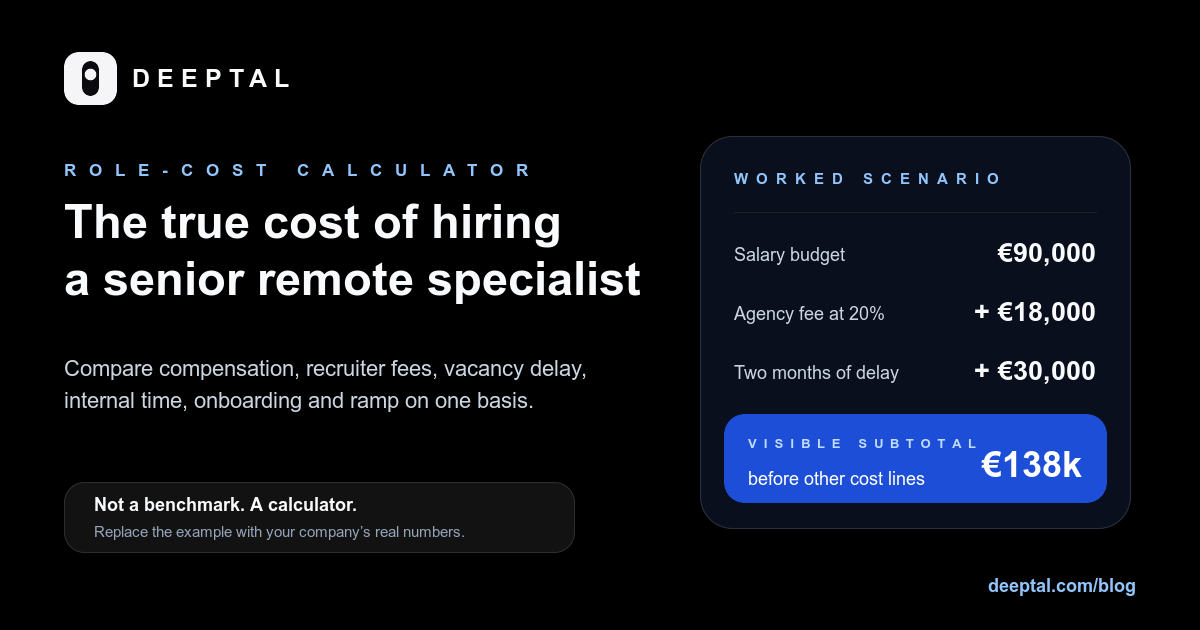
Assume a company is considering a senior role with a €90,000 annual salary budget. The company has an agency quote of 20% and estimates that leaving the work uncovered costs €15,000 per month. It expects the agency route to take two months before the person starts.
- Cash compensation: €90,000
- Agency fee: €18,000 (€90,000 × 20%)
- Vacancy cost: €30,000 (€15,000 × 2 months)
- Employer costs, benefits, and tools: insert the company’s actual figure
- Internal hiring time: insert hours × blended hourly cost
- Onboarding and ramp: insert the company’s expected figure
The visible subtotal is €138,000 before employer costs, benefits, tools, internal hiring time, onboarding, and ramp.
That subtotal is not a market average. It is the result of the stated assumptions. Change the fee to 0%, shorten or extend the vacancy period, and enter the remaining company-specific costs to compare realistic scenarios.
Compare every hiring route on the same basis
Build one column for each realistic route and keep the rows identical.
Direct employee hire
Include cash compensation, employer costs, benefits, equipment, sourcing, internal recruiting time, expected vacancy, onboarding, and ramp. Add an agency fee only if an agency is part of the route.
Recruitment agency hire
Use the same employee-cost rows, then add the quoted recruitment fee and the expected timeline for that specific search. Do not assume the fee automatically shortens time to start; use the timeline the provider is prepared to discuss with you.
Managed remote specialist
Include the specialist rate, any onboarding or platform costs, internal management time, expected time to start, and the operating work included by the provider. Confirm who handles contracts, payroll administration, compliance administration, replacements, and invoicing.
The right answer is not always the lowest first-year total. Role duration, knowledge retention, management capacity, risk, speed, and flexibility should also influence the decision.
Five questions to answer before approving the role
- What business outcome is delayed while this role is open?
- What is the monthly cost of that delay, using a low, expected, and high case?
- Which one-off fees apply, and what exactly triggers them?
- How many internal hours will sourcing, interviews, contracting, and onboarding consume?
- Which operating costs are included in the provider’s price, and which remain with us?
If the team cannot answer those questions, the role is not yet ready for a reliable cost comparison. Improve the brief before comparing providers.
Where Deeptal fits
Deeptal is designed for companies that want senior European remote specialists without a traditional recruitment fee. No recruitment fees. Deeptal handles contracts, payroll, compliance administration, and one monthly invoice.
That does not remove the need for a role-cost model. It gives buyers a clearer route to compare against direct employment and agency hiring using the same assumptions.
Build your own role-cost comparison
Compare an agency hire with Deeptal
Enter the local salary for the role. We will show the comparison using your agency fee and Deeptal's fixed 40% planning assumption.
Locked comparison assumption.
Traditional route
Recruitment agency
- Annual salary
- €90,000
- Recruitment fee
- +€18,000
Deeptal comparison
Managed remote specialist
- Estimated talent cost
- €54,000
- Recruitment fee
- €0
Under these assumptions
Deeptal is €54,000 lower in the first year.
Illustrative comparison only. The calculator uses a fixed 40% planning assumption, not a guaranteed saving. Actual specialist rates depend on the role, seniority, location, hours, and availability. Employer costs, benefits, equipment, vacancy, onboarding, and taxes are not included.
Compare your role with DeeptalIf you already know the role, outcome, budget range, and desired start window, send Deeptal a qualified role brief. We will use that brief to assess fit and next steps.
Timing depends on a qualified brief, role complexity, specialist availability, interview speed, and commercial alignment.